
In a bring-your-own-device model, MVNO faces several problems configuring the terminal. Any obstacle in this process translates into customer dissatisfaction on the onboarding process. Bad first taste for a newcomer! With APNSetting, the customer onboarding is smooth, almost transparent and makes an impressive welcome onboard!
Thanks to the automatic APN configuration process, most of the user terminals are configured as soon as the customer introduces their SIM. This leads to a significant reduction of customer care calls, dropping out severely your contact-center costs.
We are continuously researching the market, analyzing new devices and testing the configuration process to prevent issues and improve the effectiveness of the platform. We help you to take better decisions with the information gathered from our research.
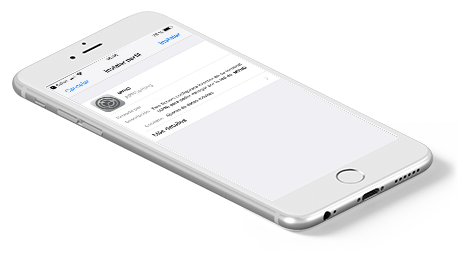
No matter whether the device is Android or iOS, the configuration process is crystal clear for the customer maximizing engagement and reducing derived costs due to Customer Care calls. Global service, scalable, reliable and 99% guaranteed to ensure your customer onboarding.
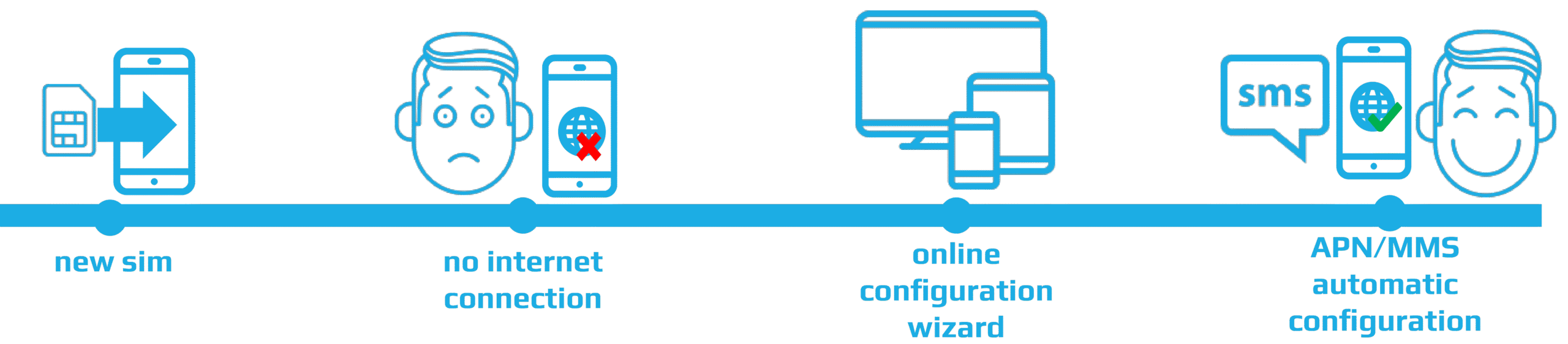
Insert your new SIM
Trigger APN configuration
Install configuration
Create and manage your dependant MVNOs if your are and MNO or MVNE, or manage your distribution and reselling network if you are a MVNO.
Real-Time reporting on the kind of devices attached to the network Data segmented by device to provide data-driven decission making to MVNOs.
Device detection by using the triplet (IMSI, MSISDN, IMEI) information. We this information the most suitable configuration method is chosen to configure the new device.
APNSETTING provides custom-branded web wizard to enable the customers configure their devices by themselves. The wizard is intuitive and two-steps process: pretty simple.
After performing the ADD function, APNSETTING automatically triggers the device configuration according to our knowledgebase most reliable method: OMA-CP, iOS profile or Setup Guide.
The Contact-Center is provided with a efficient tool to configure Customers devices quickly and without cumbersome steps. Reduce your customer care calls duration and save costs!
Keep track in real-time of statistic configurations your customers and Customer Care are performing. Manage your dependants and invoces in an easy way.
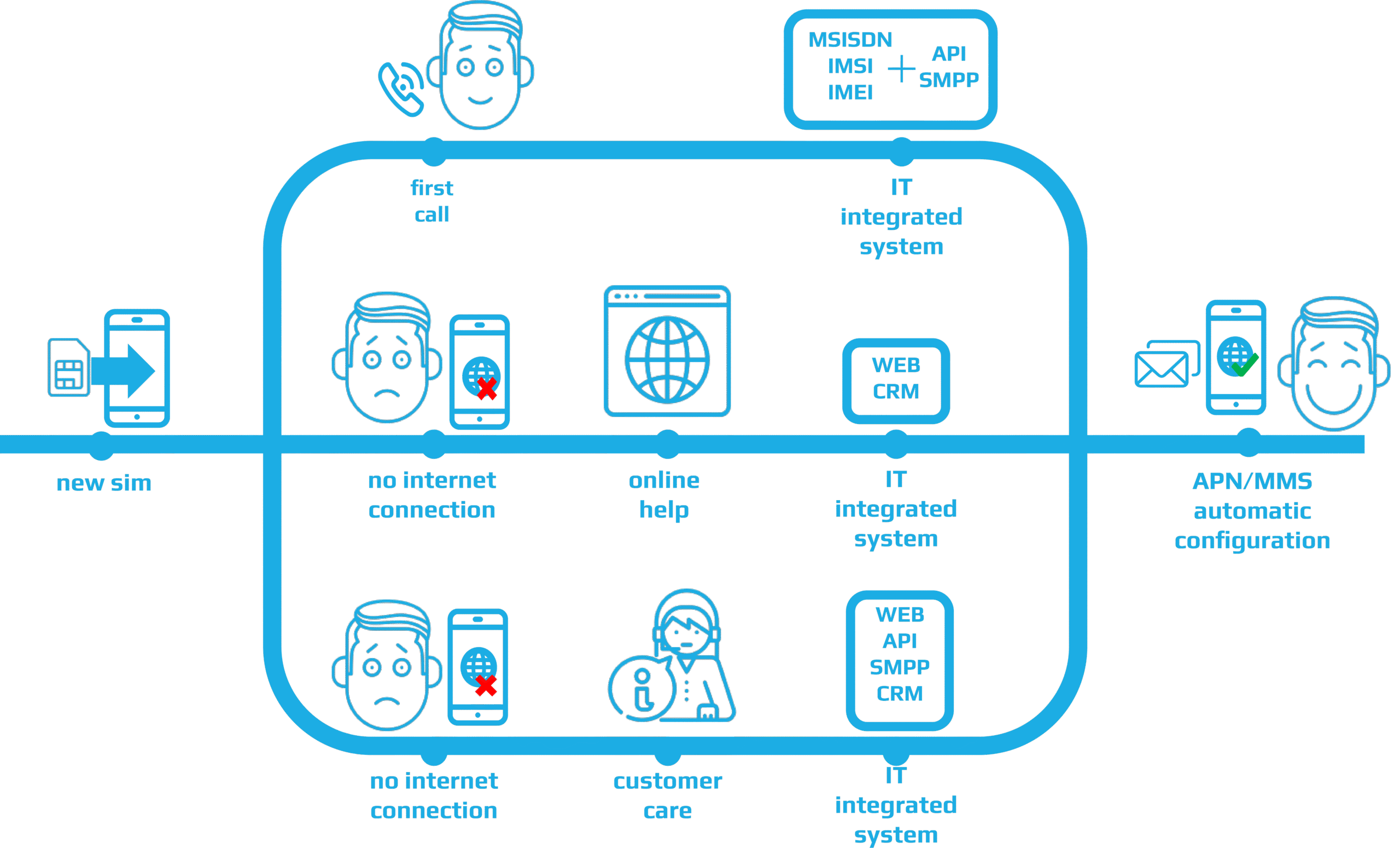
Integrate APNSETTING with your IT infrastructure to automate the Customer Onboarding and provide a fancy User Experience and increasing engagement and loyalty.
APNSETTING provides an Application Programming Interface (API) capable to perform several levels of integration in the IVR, CRM or on CDR. The API may make use of certain parameters as IMEI to improve configuration success and IMSI to secure the config reception.
Trigger automatic APN settings from your SMSC enabling Short Message configuration requests.
Whenever the automatic APN settings is launched from the Contact Center, the process is pretty simple: just select the device Operating System, put in the customer phone number and go!
APNSETTING provides web wizards to simplify the APN settings configuration for the users by their own.
The APN settings webs are design responsive to be smoothly accessed from any kind of device. The User Experience of the solution is optimize to success.
Web Wizards optimized for Contact Center Operators. Every saved minute in supporting your customer impacts directly in cutting off the Customer Care costs.
Whenever the automatic APN settings is launched from the Contact Center, the process is pretty simple: just select the device Operating System, put in the customer phone number and go!
Customer onboarding represents the most critical 72 hours of your subscriber relationship. New customers insert their SIM expecting instant connectivity, yet 35-40% contact support within 48 hours because devices fail to configure automatically. Each manual configuration support call costs €8-15 in agent time, infrastructure, and follow-up resources. For MVNOs acquiring 10,000 subscribers monthly, APN-related issues generate €120,000 in unnecessary support expenses every single month.
Our automatic APN and MMS configuration service eliminates this friction entirely through intelligent OTA provisioning that configures devices within 30 seconds of SIM activation. The platform detects device profiles—manufacturer, model, OS version—then delivers precisely calibrated parameters via OMA-CP messages, iOS configuration profiles, or responsive web wizards. Subscribers experience seamless connectivity without technical knowledge, manual settings, or support interactions. Your operational costs drop dramatically while customer satisfaction scores improve from the moment they activate service.
First impressions define customer relationships, especially in competitive MVNO markets where switching costs remain low. When subscribers struggle with manual APN entry during activation, you create negative brand associations before delivering any actual service value. The frustration compounds when customers navigate confusing settings menus, enter cryptic parameter names, and troubleshoot connectivity failures they don’t understand. This experience damages engagement before the relationship begins and increases early-stage churn by 25-40%.
Automatic configuration transforms this critical moment into a seamless welcome experience. Subscribers insert their SIM, receive an instant configuration prompt, tap “Accept,” and connect immediately. The entire process completes within 30 seconds without requiring technical knowledge or documentation searches. This friction-free onboarding creates positive first impressions that improve long-term engagement—subscribers who experience seamless activation show 35% higher retention rates after six months compared to those who required manual configuration support.
The engagement benefits extend beyond initial activation. When customers switch devices or travel internationally, automatic reconfiguration eliminates the common pain points that typically generate support calls. A subscriber upgrading from Android to iPhone receives appropriate iOS configuration profiles automatically. A traveler entering roaming zones gets updated APN settings for optimal international data connectivity. These invisible service improvements build confidence in your infrastructure and reduce subscriber temptation to switch providers when device changes create temporary inconveniences.
Support cost reduction represents the most measurable ROI from APN automation. Traditional MVNO operations accept manual configuration support as inevitable overhead—agents walking customers through settings menus, troubleshooting parameter entry errors, and handling callbacks when initial instructions fail. These repetitive, low-value interactions consume enormous resources: agents spending 15-20 minutes per call, supervision overhead, quality assurance, and infrastructure capacity dedicated to predictable, preventable issues.
Automatic provisioning eliminates these costs at the source. When configurations deploy via OTA protocols, support agents never see the ticket. The platform handles device detection, parameter selection, and delivery confirmation autonomously. For an MVNO handling 50,000 monthly activations with historical 35% support contact rates, automation eliminates approximately 13,000 support tickets monthly. At €10 average cost per ticket, monthly savings reach €130,000—€1.56 million annually in direct support cost reduction.
The cost benefits compound through secondary effects. Support agents previously consumed by manual configuration now handle revenue-generating activities—upselling premium plans, troubleshooting complex technical issues that require human judgment, or managing high-value enterprise accounts. Contact center infrastructure operates more efficiently when call volumes drop 60-75%, allowing you to defer capacity expansion investments or redeploy resources to customer acquisition instead of operational overhead. Quality metrics improve because agents spend time on meaningful interactions rather than robotic script recitation.
Device ecosystem complexity creates continuous operational challenges for MVNOs. Manufacturers release new smartphone models monthly, Android updates modify configuration requirements quarterly, and iOS versions introduce subtle parameter changes that break existing provisioning logic. Maintaining accurate configuration databases requires dedicated resources monitoring device launches, testing configuration procedures, and updating documentation across all support channels. Most MVNOs lack capacity for this continuous research, resulting in outdated configuration guides and rising support volumes as device populations evolve.
Our platform includes comprehensive device knowledge base maintenance as core service infrastructure. Our research team monitors global device launches across 200+ manufacturers, tests configuration procedures against actual hardware, and validates OTA delivery success rates before updating production databases. When Samsung releases new Galaxy firmware, when Xiaomi modifies Android skin behavior, when Apple changes iOS provisioning protocols—we identify these changes proactively and update platform logic to maintain seamless operation.
This continuous research delivers strategic value beyond operational efficiency. The platform’s device analytics reveal actual smartphone populations across your subscriber base, showing which manufacturers dominate, which OS versions require support, and which device categories experience configuration issues. This intelligence informs network planning decisions—if 40% of your subscribers use high-end smartphones, premium data plans become viable upsell targets. If IoT device penetration exceeds expectations, specialized M2M offerings gain business justification. The data transforms device management from reactive problem-solving to strategic planning based on actual subscriber behavior.
Comprehensive device support defines platform value in BYOD environments. Your subscribers arrive with devices spanning the entire smartphone ecosystem—flagship iPhones, mid-range Android devices, budget smartphones from regional manufacturers, and legacy devices running outdated OS versions. Each platform requires different provisioning approaches: OMA-CP messages for Android, configuration profiles for iOS, manual guides for feature phones. Managing this complexity through manual processes becomes operationally impossible at scale.
Our platform maintains dedicated configuration pathways for every major device category. Android devices receive OMA-CP provisioning messages delivered via SMS or binary push, formatted according to manufacturer-specific requirements. Samsung devices running One UI receive configurations optimized for their custom Android implementation. Huawei EMUI, Xiaomi MIUI, Oppo ColorOS—each manufacturer’s Android variant gets precisely calibrated parameters that account for their unique network handling characteristics.
iOS provisioning uses Apple’s official carrier settings format, delivered through OMA-CP or signed configuration profiles depending on iOS version and device capabilities. The platform automatically detects iPhone models and iOS versions, applying appropriate provisioning methods that respect Apple’s security requirements while ensuring settings persist across iOS updates. This attention to platform-specific details prevents the common issue where configurations work initially but disappear after OS updates, eliminating a major source of repeat support calls.
Accurate device detection determines provisioning success. When platforms guess device types based on limited data, configuration failures increase dramatically—wrong parameters delivered to incompatible devices, iOS settings sent to Android phones, or generic configurations that work poorly across device-specific network optimizations. These failures generate the exact support calls automation should prevent, undermining ROI and damaging customer experience.
Our Automatic Device Detection (ADD) engine uses the complete triplet of IMSI, MSISDN, and IMEI data to identify devices with exceptional accuracy. The IMEI provides manufacturer, model, and hardware capabilities. The IMSI confirms subscriber identity and network authorization. The MSISDN enables SMS delivery verification and provisioning confirmation. This multi-source detection achieves 98% device identification accuracy compared to 60-70% for systems relying solely on user agent strings or IMEI databases.
The detection engine maintains a database covering 50,000+ unique device profiles, updated continuously as new models launch globally. When encountering unknown devices, the platform logs characteristics for manual research while applying conservative configurations that work across 95% of smartphones. This fallback ensures immediate service rather than configuration failures, while our research team identifies optimal parameters within 24-48 hours for future deployments. The database learns continuously, improving accuracy as your actual subscriber device population provides real-world validation data.
Different devices demand different provisioning methods for optimal success rates. OMA-CP messages work excellently across most Android devices but fail on iOS. Apple’s configuration profiles deliver seamless iPhone provisioning but offer no value for Android. Feature phones and some budget smartphones support neither protocol, requiring web-based manual guides. Comprehensive platform capability requires supporting all provisioning methods simultaneously, selecting the optimal approach for each specific device.
Our Automatic Device Configuration (ADC) function matches detected devices to appropriate provisioning methods from our validated knowledge base. High-end Android devices receive OMA-CP binary messages delivered via SMS, triggering instant system-level configuration installation. iOS devices get signed configuration profiles that install with single-tap acceptance, preserving settings across iOS updates and device backups. Budget smartphones without OTA support receive SMS containing personalized web wizard links with device-specific visual configuration guides.
This multi-method approach achieves 99.5% configuration success rates across entire subscriber populations. The platform automatically handles method selection, fallback sequencing, and retry logic without manual intervention. If primary OMA-CP delivery fails due to SMS filtering, the system attempts data channel delivery. If both fail, it triggers web wizard fallback. This layered approach eliminates the single-point-of-failure problem that plagues single-method provisioning systems, ensuring subscribers always reach connectivity regardless of device capabilities or network conditions.
Self-service capabilities reduce support dependency while improving customer satisfaction. Subscribers who can resolve issues independently without waiting in call queues experience higher satisfaction than those requiring agent assistance, even when agents provide perfect service. Self-care also delivers cost benefits—web wizard configurations cost €0.50-1.00 per completion versus €8-15 for agent-assisted calls, creating 85-95% cost reduction for successfully deflected support interactions.
Our custom-branded web wizards provide intuitive self-service configuration that subscribers complete in under two minutes. The wizard detects device types automatically using browser user agent analysis, then displays two-step visual guides customized for that specific device. Step one shows exactly where to find APN settings in that device’s menu structure. Step two provides pre-filled parameters subscribers copy directly into settings fields. The process eliminates guesswork and reduces user error to near-zero levels.
The wizards deploy fully branded with your MVNO’s identity—logos, color schemes, support contact information, and messaging tone matching your brand voice. This branding maintains consistent customer experience while building confidence in your infrastructure. Subscribers perceive the wizard as your proprietary technology rather than third-party service, reinforcing brand value during technical interactions. The responsive design ensures perfect functionality across desktop browsers, mobile web, and tablet interfaces, supporting the increasing percentage of subscribers who manage accounts entirely through smartphones.
Despite automation success, some configuration scenarios still require human support—subscribers with disabled SMS reception, devices behind corporate firewalls blocking OTA delivery, or elderly customers needing step-by-step verbal guidance. These scenarios demand agent intervention, but traditional approaches waste enormous time navigating documentation, researching device-specific procedures, and troubleshooting parameter entry errors during live calls.
Our customer care operator web wizard streamlines agent-assisted provisioning into a 60-90 second process. Agents select device operating system from a dropdown, enter the customer’s phone number, and click “Send Configuration.” The platform handles device detection, parameter selection, and OTA delivery while the agent remains on the call to confirm receipt. This simplified workflow reduces average handling time from 15-20 minutes to under two minutes, improving contact center efficiency by 85%+ for configuration-related inquiries.
The operator interface includes built-in troubleshooting workflows for common failure scenarios. If OTA delivery fails, the system immediately presents alternative options—generate device-specific SMS instructions, send web wizard links, or display visual guides the agent can describe verbally to customers. This decision tree eliminates the problem of agents becoming stuck during calls, reducing call transfers and improving first-contact resolution rates. The interface also logs all interactions for quality assurance and analytics, enabling continuous improvement of support procedures based on actual call patterns.
Operational visibility drives continuous improvement. Without detailed analytics on configuration success rates, device distributions, and provisioning method effectiveness, MVNOs operate blind to optimization opportunities. Support costs remain higher than necessary because teams cannot identify which devices cause disproportionate issues, which provisioning methods underperform, or which subscriber segments experience friction during onboarding.
Our customer dashboard provides real-time statistics on all configuration activity across your subscriber base. Track daily, weekly, and monthly provisioning volumes segmented by device manufacturer, OS version, and delivery method. Identify success rates for OMA-CP versus iOS profiles versus web wizards, revealing which approaches work best for your actual device population. Monitor geographic distribution of configuration requests, highlighting regions where device ecosystems differ from national averages and may require specialized attention.
The analytics enable data-driven decision making across multiple operational areas. Procurement teams use device distribution data to negotiate better wholesale device pricing with manufacturers whose products dominate your subscriber base. Marketing teams identify device trends early—rising iPhone penetration signals opportunities for premium plan positioning, while IoT device growth justifies M2M service development. Support teams optimize training and documentation by focusing on device categories that generate actual support volume rather than theoretical coverage of every possible smartphone model.
MVNEs serving multiple MVNO brands and MVNOs operating reseller networks require hierarchical management capabilities that respect business relationships. Each MVNO brand needs independent control over configurations, branding, and subscriber data while sharing infrastructure costs and technical capabilities. Traditional single-tenant platforms force complex workarounds or require separate deployments for each brand, creating unnecessary cost and operational complexity.
Our multi-tenant architecture supports unlimited hierarchical structures—MVNE parent accounts managing multiple MVNO children, or MVNO primary brands controlling distribution partner subaccounts. Each tenant maintains complete data isolation: subscriber information, configuration analytics, and provisioning logs never mix between brands. Parent accounts control infrastructure-wide settings—security policies, API access, default configurations—while child tenants customize their specific parameters, web wizard branding, and support workflows.
This structure mirrors your business relationships precisely. MVNEs can white-label the entire platform to partner MVNOs, who perceive it as your proprietary infrastructure. MVNOs managing dealer networks grant limited access to distributors—allowing them to provision customers directly while maintaining central control over configuration policies and analytics visibility. The billing architecture supports flexible cost allocation: MVNEs can absorb infrastructure costs as value-added services, pass them through to MVNOs directly, or hybrid models where basic provisioning is included but premium analytics require surcharges.
Deep infrastructure integration determines automation effectiveness. Standalone tools requiring manual triggers provide limited value—agents still need to remember to initiate provisioning, subscribers must request configurations explicitly, and the process remains vulnerable to human error and delays. True automation requires bidirectional API connectivity where provisioning triggers automatically based on events in your billing, CRM, or activation systems.
Our comprehensive API enables multiple integration approaches matching your infrastructure architecture. RESTful endpoints support synchronous provisioning—your activation system calls our API with MSISDN and IMEI, receives immediate confirmation, and completes the activation transaction. Webhook callbacks enable asynchronous workflows where our platform sends delivery confirmations and failure alerts to your systems, allowing automated retry logic or support ticket generation for failed provisioning attempts.
The API documentation includes complete SDKs for major programming languages—Java, Python, PHP, .NET, and Node.js—with working example code for common integration scenarios. Sandbox environments provide realistic testing infrastructure where you validate integration logic against simulated provisioning workflows before production deployment. Our technical team provides dedicated integration support: architecture review sessions where we map your existing systems, development assistance when your team encounters implementation challenges, and testing collaboration to ensure all edge cases function correctly before go-live.
SMS-based provisioning demands reliable, low-latency delivery to ensure subscribers receive configurations within seconds of SIM activation. Traditional approaches route provisioning messages through multiple intermediary services—API gateways, SMS aggregators, international routing providers—adding latency and failure points. Each intermediary introduces 3-5 seconds of delay and 1-2% delivery failure probability. These delays compound frustration during the critical onboarding window when subscribers expect instant connectivity.
SMPP integration provides direct connectivity to your SMSC (Short Message Service Center), eliminating intermediaries and reducing provisioning latency from 10-15 seconds to under three seconds. The platform maintains persistent SMPP connections in bind transceiver mode, enabling bidirectional messaging for provisioning delivery and receipt confirmation. This architecture ensures messages route through your infrastructure exclusively, supporting regulatory requirements in markets where subscriber communications must transit domestic infrastructure.
The SMPP implementation supports advanced features critical for enterprise-grade provisioning: delivery receipt tracking with retry logic for failed messages, throughput throttling to respect SMSC rate limits, and automatic failover between primary and backup SMSC connections. When primary SMSC infrastructure experiences issues, the platform immediately switches to backup routes while alerting your operations team. This redundancy ensures provisioning continuity even during infrastructure maintenance or unexpected outages, maintaining the 99.9% uptime SLA that telecom operations demand.
Web wizard effectiveness depends entirely on user experience quality. Complex interfaces, unclear instructions, or poor mobile optimization create friction that defeats self-service purposes. Subscribers abandon configuration attempts, contact support instead, and develop negative perceptions about your brand’s technical capabilities. The self-service cost savings you expected transform into increased support volume plus brand damage from failed digital interactions.
Our web wizards employ mobile-first responsive design optimized for smartphone browsers where most configuration attempts originate. Touch-optimized buttons replace small clickable links. Clear visual hierarchies guide users through two-step processes without confusion. Parameter copying functions place “Copy to Clipboard” buttons directly adjacent to each configuration value, eliminating manual selection errors that frequently cause mistyped APNs or proxy addresses.
The design undergoes continuous A/B testing and user experience optimization. We track completion rates, abandonment points, and time-to-completion across thousands of daily interactions, identifying friction points and testing design improvements. When data shows subscribers struggling with specific steps, we redesign those interactions and measure impact. This continuous optimization means wizard effectiveness improves month-over-month without requiring your team’s involvement—you benefit from insights gathered across our entire MVNO client base without conducting your own UX research.
APN configuration typically focuses on mobile data connectivity, but multimedia messaging represents equally important functionality that subscribers expect to work automatically. MMS failures create support calls just as frustrating as data connectivity issues—subscribers cannot share photos, receive group messages, or participate in modern messaging ecosystems. These failures occur even when basic data works perfectly because MMS requires separate MMSC (Multimedia Messaging Service Center) configuration with specific proxy and port settings.
Our platform provisions complete MMS parameters alongside data APN settings in every configuration delivery. The OMA-CP messages or iOS profiles include MMSC URL, MMS proxy address, port configurations, and authentication credentials when required. This comprehensive approach ensures subscribers experience complete service functionality immediately—data browsing, app connectivity, and multimedia messaging all work seamlessly from first SIM insertion.
MMS configuration proves especially critical for MVNOs targeting consumer markets where messaging remains central to smartphone usage. When subscribers cannot send photo messages or participate in group chats, they perceive service as fundamentally broken regardless of data speeds or voice quality. Automatic MMS provisioning prevents these perception issues while eliminating another major support call category—our clients report 30-40% of configuration-related support involves MMS specifically, representing substantial additional cost savings beyond basic APN automation benefits.
Provisioning systems handle sensitive subscriber data—phone numbers, device identifiers, network credentials—requiring security standards equivalent to core telecom infrastructure. Inadequate security exposes subscriber information to unauthorized access, enables service fraud through configuration manipulation, and creates compliance violations under GDPR, telecom regulations, and industry security standards. These risks demand enterprise-grade security architecture, not consumer SaaS approaches.
Our platform employs defense-in-depth security with multiple protective layers. All API communications use TLS 1.3 encryption with perfect forward secrecy, ensuring intercepted traffic cannot be decrypted even if future key compromises occur. OMA-CP messages include digital signatures preventing tampering during SMS transmission. Authentication combines API keys, IP whitelisting, and optional mutual TLS for maximum-security deployments. Rate limiting prevents abuse and DDoS attacks while maintaining throughput for legitimate provisioning volumes.
The infrastructure maintains ISO 27001 certification with annual third-party security audits covering application security, infrastructure hardening, and operational procedures. Penetration testing occurs quarterly, with mandatory remediation of identified vulnerabilities before subsequent testing cycles. All subscriber data maintains encryption at rest using AES-256, with encryption keys managed through hardware security modules that meet FIPS 140-2 Level 3 standards. This comprehensive security approach ensures compliance across GDPR, PCI-DSS, and regional telecom regulations from EU ePrivacy to APAC data sovereignty laws.
International MVNO operations require infrastructure that respects regional requirements for data residency, regulatory compliance, and network performance. Provisioning systems deployed exclusively in single regions introduce latency for international operations, create data sovereignty compliance issues, and may violate telecommunications regulations requiring domestic data processing. These limitations force complex workarounds or prevent international expansion entirely.
Our platform operates across regional data centers in EU, US, and APAC, supporting flexible deployment models that meet your specific geographic requirements. European MVNOs can deploy exclusively within EU infrastructure, ensuring GDPR compliance and sub-100ms provisioning latency across the continent. Multi-regional MVNOs operate separate instances in each geography, with centralized management dashboards providing unified visibility across all deployments.
Regional deployments include localization beyond simple data center placement. Device databases incorporate region-specific smartphone models popular in local markets—Xiaomi variants dominating Asia, Tecno and Infinix devices common in Africa, regional brands prevalent in Latin America. Configuration templates adapt to local network characteristics and operator preferences. Support documentation and customer-facing wizards deploy in local languages, ensuring subscribers experience native-language interactions rather than poorly translated interfaces. This comprehensive localization enables consistent service quality globally while respecting regional differences that impact actual subscriber experience.
Commercial flexibility determines platform accessibility across MVNOs of varying sizes and business models. Fixed enterprise pricing excludes smaller operators who cannot justify upfront investments for subscriber bases under 100,000. Pure per-transaction pricing creates unpredictable costs that complicate budgeting for high-growth MVNOs. Rigid contracts prevent MVNOs from adapting commercial terms as their businesses evolve through different growth phases.
Our pricing supports multiple commercial models adapting to your specific situation. Volume-based transaction pricing works for established MVNOs with predictable activation rates—pay per successful configuration delivery with tiered rates that decrease as monthly volumes increase. This model aligns costs directly with subscriber growth and eliminates baseline fees during slower growth periods. Minimum commitments ensure cost predictability while volume discounts reward growth.
Small MVNOs and new launches benefit from hybrid models combining modest baseline subscriptions with per-transaction fees above included volumes. This structure provides budget predictability during uncertain early growth while preventing excessive costs during rapid scaling. MVNEs serving multiple MVNO brands access wholesale pricing with flexible sublicense terms, enabling profitable resale to partner MVNOs while maintaining margin flexibility.
Deployment speed determines time-to-value for automation investments. Extended implementation cycles delay cost savings, prolong subscriber friction during manual configuration periods, and increase integration risk through scope creep. Successful deployments follow structured approaches that balance thoroughness with execution speed, delivering production capability within weeks rather than months.
Our standard implementation follows a four-week timeline from contract signature to production launch. Week one covers technical discovery and API provisioning—our team reviews your infrastructure architecture, identifies integration points, and provides API credentials plus sandbox access. Your development team begins SDK integration using our example code and technical documentation. Week two focuses on integration development and testing—your team implements API calls from billing or activation systems while we validate message formatting and delivery logic in sandbox environments.
Week three manages user acceptance testing with production-like data but isolated from live subscriber traffic. You validate configuration accuracy across representative device samples from your actual subscriber base, test failure scenarios and fallback mechanisms, and confirm analytics dashboards display correct data. Week four handles production deployment using graduated rollout—start with 10% of new activations, monitor success rates for 48 hours, then scale to 50% and ultimately 100% as confidence builds. This cautious approach minimizes risk while achieving full production capability within one month.
How does automatic APN configuration reduce customer care costs?
Automatic provisioning eliminates 60-75% of configuration-related support tickets by delivering settings via OTA protocols before subscribers encounter connectivity issues. Each prevented support call saves €8-15 in agent time and infrastructure costs. For an MVNO activating 10,000 subscribers monthly with historical 35% support contact rate, automation eliminates approximately 2,600 monthly tickets, saving €26,000-39,000 monthly or €312,000-468,000 annually in direct support cost reduction.
What provisioning methods does the platform support?
The platform delivers configurations via OMA-CP binary messages for Android devices, Apple configuration profiles for iOS devices, and responsive web wizards for devices without OTA support. The system automatically selects optimal provisioning methods based on device detection, with intelligent fallback sequencing ensuring 99.5% configuration success across all device types including legacy smartphones and feature phones.
How accurate is automatic device detection?
Our Automatic Device Detection (ADD) achieves 98% accuracy using the complete triplet of IMSI, MSISDN, and IMEI data. The platform maintains a database covering 50,000+ device profiles updated continuously as manufacturers release new models. For unknown devices, conservative fallback configurations ensure immediate connectivity while our research team identifies optimal parameters within 24-48 hours for future provisioning attempts.
Can we customize web wizard branding for our MVNO?
Yes, web wizards deploy fully customized with your branding including logos, color schemes, domain names, and messaging tone. The responsive design ensures perfect functionality across desktop, mobile, and tablet interfaces. Customization includes multi-language support for international operations, allowing subscribers to configure devices in their native languages with region-specific instructions.
What integration options work with our existing billing system?
The platform connects via RESTful APIs, SMPP for SMS-based delivery, or webhooks for event-driven architectures. Integration supports major billing platforms including Oracle BRM, Ericsson Charging, and custom in-house systems. Implementation includes complete SDKs for Java, Python, PHP, and .NET, with sandbox environments for testing and dedicated technical support throughout 3-4 week integration timelines.
How does multi-tenant management work for MVNEs?
The multi-tenant architecture supports unlimited hierarchical structures where parent MVNE accounts manage infrastructure-wide settings while child MVNO tenants control their specific configurations and branding. Complete data isolation ensures subscriber information never mixes between tenants. MVNEs can white-label the platform to partner MVNOs with flexible cost allocation supporting value-added service models or direct pass-through billing.
What happens when OTA provisioning fails?
The platform implements automatic fallback mechanisms when primary OTA delivery fails. If SMS-based OMA-CP fails, the system attempts data channel delivery. If both fail, subscribers receive SMS containing personalized web wizard links with device-specific visual guides. This layered approach achieves 99.5% ultimate configuration success by adapting to device capabilities and network conditions rather than relying on single provisioning methods.
Does the platform support MMS configuration alongside data APN?
Yes, all provisioning messages include complete MMS parameters—MMSC URL, proxy addresses, port configurations, and authentication credentials. This comprehensive approach ensures subscribers experience full service functionality including multimedia messaging, group chats, and photo sharing without requiring separate configuration steps or support interactions. MMS provisioning eliminates 30-40% of configuration-related support calls specifically related to messaging failures.
What security standards and compliance certifications does the platform maintain?
The platform maintains ISO 27001 certification with annual third-party security audits, GDPR compliance for EU operations, and regional data residency in EU, US, and APAC data centers. All communications use TLS 1.3 encryption, OMA-CP messages include digital signatures, and subscriber data encrypts at rest using AES-256 with FIPS 140-2 Level 3 key management. The infrastructure undergoes quarterly penetration testing with mandatory vulnerability remediation.
How quickly can we achieve ROI after deployment?
Most MVNOs achieve positive ROI within 30-60 days. Implementation costs typically range €15,000-30,000 depending on integration complexity, recovered through support cost savings within the first two months of operation. A typical operator handling 10,000 monthly activations saves €26,000-39,000 monthly in reduced support costs, delivering 12-month ROI exceeding 500-800% on initial investment while improving customer satisfaction and reducing early-stage churn.